The spatiotemporal distribution of potential saxitoxin-producing cyanobacteria in western Lake Erie

Callie Nauman, Keara Stanislawczyk, Laura A. Reitz, Justin D. Chaffin

Abstract

Cyanobacterial blooms in the western basin of Lake Erie have been well studied with a focus on planktonic Microcystis and the cyanotoxin microcystin, but recent research has shown that blooms are not entirely Microcystis. Previous studies have documented other taxa in blooms capable of producing other cyanotoxins. Furthermore, benthic cyanobacteria have historically been overlooked in Lake Erie. Saxitoxin is a cyanotoxin of emerging concern in freshwater, and the sxtA gene which encodes its production has been found in the Maumee River and central basin of Lake Erie. Collectively, these points indicated that saxitoxin-producing cyanobacteria may also occur in the western basin. We utilized three sources of data to determine the spatial and temporal distribution of potential saxitoxin-producing cyanobacteria in the water column (years 2018–2022) and deployed nutrient diffusing substrata (NDS) to determine the impact of nutrients, depth, and season on potential-STX producing benthic cyanobacteria (years 2018 & 2019). The water column datasets showed that “hotspots” of sxtA lasted only a few weeks. sxtA gene copies per mL did not correlate with Dolichospermum or Aphanizomenon biovolume, which have been associated with sxtA elsewhere. In the NDS, saxitoxin (ng/cm2) and cyanobacteria chlorophyll were inversely correlated with the highest saxitoxin in September and at the deeper depth, whereas cyanobacteria chlorophyll was highest during June and at the shallower depth. This research suggests continued monitoring is needed to determine drivers of saxitoxin in the western basin, and we recommend that future Lake Erie cyanobacteria research should not solely focus on microcystins and planktonic blooms.

Risk assessment of toxic cyanobacterial blooms in recreational waters: A comparative study of monitoring methods

Quirijn J.F. Schürmann a,c , Petra M. Visser a , Susan Sollie b , W. Edwin A. Kardinaal c , Elisabeth J. Faassen d,e

Click here to read the paper.

Quirijn J.F. Schürmann a,c , Petra M. Visser a , Susan Sollie b , W. Edwin A. Kardinaal c , Elisabeth J. Faassen d,e , Ridouan Lokmani f , Ron van der Oost g , Dedmer B. Van de Waal

Harmful Algae 138 (2024) 102683

Abstract

Toxic cyanobacterial blooms impose a health risk to recreational users, and monitoring of cyanobacteria and associated toxins is required to assess this risk. Traditionally, monitoring for risk assessment is based on cyanobacterial biomass, which assumes that all cyanobacteria potentially produce toxins. While these methods may be cost effective, relatively fast, and more widely accessible, they often lead to an overestimation of the health risk induced by cyanotoxins. Monitoring methods that more directly target toxins, or toxin producing genes, may provide a better risk assessment, yet these methods may be more costly, usually take longer, or are not widely accessible. In this study, we compared six monitoring methods (fluorometry, microscopy, qPCR of 16S and mcyE, ELISA assays, and LC-MS/MS), of which the last three focussed on the most abundant cyanotoxin microcystins, across 11 lakes in the Netherlands during the bathing water season (May-October) of 2019. Results of all monitoring methods significantly correlated with LC-MS/MS obtained microcystin levels (the assumed ‘golden standard’), with stronger correlations for methods targeting microcystins (ELISA) and microcystin genes (mcyE). The estimated risk levels differed substantially between methods, with 78 % and 56 % of alert level exceedances in the total number of collected samples for fluorometry and microscopy-based methods, respectively, while this was only 16 % and 6 % when the risk assessment was based on ELISA and LC-MS/MS obtained toxin concentrations, respectively. Integrating our results with earlier findings confirmed a strong association between microcystin concentration and the biovolume of potential microcystin-producing genera. Moreover, using an extended database consisting of 4265 observations from 461 locations across the Netherlands in the bathing water seasons of 2015 – 2019, we showed a strong association between fluorescence and the biovolume of potentially toxin-producing genera. Our results indicate that a two-tiered approach may be an effective risk assessment strategy, with first a biomass-based method (fluorometry, biovolume) until the first alert level is exceeded, after which the risk level can be confirmed or adjusted based on follow-up toxin or toxin gene analyses.

Microcystin contamination of estuarine bivalves downstream of freshwater cyanobacterial blooms

Click here to read the full paper.

Marcella Kretz Wallace, Raphael M. Kudela b Marine Pollution Bulletin Volume 214, May 2025

Abstract

Estuaries are dynamic environments that provide vital habitat to ecologically and commercially important bivalves. In some cases, freshwater tributaries can introduce cyanobacteria and associated cyanotoxins into estuaries that may subsequently accumulate in estuarine bivalves. Temporarily open/closed estuaries (TOCEs), which only experience tidal input for limited periods of time, may be particularly vulnerable to the accumulation of cyanotoxins in bivalves as they can be subject to freshwater input without tidal flushing and may experience lower salinities and cyanobacterial blooms. This study quantified levels of microcystin in bivalves collected as a time series over a five-year period (2017–2021) from Mecox Bay, a TOCE on Long Island, NY, USA, that hosts a productive oyster fishery and is downstream of a freshwater body that hosts microcystin-producing cyanobacterial blooms. During the study, microcystin was detected in all bivalves monitored including Eastern oysters (Crassostrea virginica), blue mussels (Mytilus edulis), and soft-shell clams (Mya arenaria), with levels in oysters exceeding those in other species and frequently exceeding 10 ng g−1, the California regulatory action level for microcystin in tissue. While oysters were capable of depurating 60–90 % of microcystin after four-to-six weeks during summer, microcystin loads in bivalves often peaked in cooler months after water column cyanobacteria and microcystin levels had seasonally declined, suggesting toxin depuration slowed at colder temperatures. Multiple linear regression models established that time-integrated measurements of pelagic microcystin concentrations in freshwater and estuarine locations, water temperature (inverse correlation), and salinity had highly significant (r2 = 0.71; p < 0.001) predictive power of the microcystin content in oysters. These findings demonstrate that bivalves, particularly oysters, in TOCEs located downstream of microcystin-producing cyanobacterial blooms are vulnerable to microcystin contamination, especially during fall months when temperature-dependent toxin depuration rates are likely slow.

On-Farm Workflow for Predictive Management of Paralytic Shellfish Toxin

Click here to read the paper….

Rendy Ruvindy, Penelope A. Ajani, Sereena Ashlin, Gustaaf Hallegraeff, Kerstin Klemm, Christopher J. Bolch, Sarah Ugalde, Mark Van Asten, Stephen Woodcock, Matthew Tesoriero, Shauna A. Murray*

Abstract

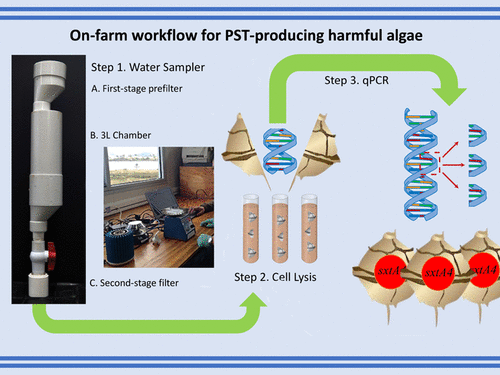
Paralytic shellfish toxins (PSTs) produced by marine dinoflagellates significantly impact shellfish industries worldwide. Early detection on-farm and with minimal training would allow additional time for management decisions to minimize economic losses. Here, we describe and test a standardized workflow based on the detection of sxtA4, an initial gene in the biosynthesis of PSTs. The workflow is simple and inexpensive and does not require a specialized laboratory. It consists of (1) water collection and filtration using a custom gravity sampler, (2) buffer selection for sample preservation and cell lysis for DNA, and (3) an assay based on a region of sxtA, DinoDtec lyophilized quantitative polymerase chain reaction (qPCR) assay. Water samples spiked with Alexandrium catenella showed a cell recovery of >90% when compared to light microscopy counts. The performance of the lysis method (90.3% efficient), Longmire’s buffer, and the DinoDtec qPCR assay (tested across a range of Alexandrium species (90.7–106.9% efficiency; r2 > 0.99)) was found to be specific, sensitive, and efficient. We tested the application of this workflow weekly from May 2016 to 30th October 2017 to compare the relationship between sxtA4 copies L–1 in seawater and PSTs in mussel tissue (Mytilus galloprovincialis) on-farm and spatially (across multiple sites), effectively demonstrating an ∼2 week early warning of two A. catenella HABs (r = 0.95). Our tool provides an early, accurate, and efficient method for the identification of PST risk in shellfish aquaculture.

An innovative passive sampling approach for the detection of cyanobacterial gene targets in freshwater sources.

Science of The Total Environment

Volume 892, 20 September 2023, 164593

David J. Redden, Toni Stanhope, Lindsay E. Anderson a, Jessica Campbell b, Wendy H. Krkošek b, Graham A. Gagnon

Abstract

Cyanotoxins pose significant human health risks, but traditional monitoring approaches can be expensive, time consuming, and require analytical equipment or expertise that may not be readily available. Quantitative polymerase polymerase Quantitative polymerase chain reaction reaction (qPCR) is becoming an increasingly common monitoring strategy as detection of the genes responsible for cyanotoxin synthesis can be used as an early warning signal. Here we tested passive sampling of cyanobacterial DNA as an alternative to grab sampling in a freshwater drinking supply lake with a known history of microcystin-LR. DNA extracted from grab and passive samples was analyzed via a multiplex qPCR assay that included gene targets for four common cyanotoxins. Passive samples captured similar trends in total cyanobacteria and the mcyE/ndaF gene responsible for microcystin production when compared to traditional grab samples. Passive samples also detected genes associated with the production of cylindrospermopsin and saxitoxin that were not detected in grab samples. This sampling approach proved a viable alternative to grab sampling when used as an early warning monitoring tool. In addition to the logistical benefits of passive sampling, the detection of gene targets not detected by grab samples indicates that passive sampling may allow for a more complete profile of potential cyanotoxin risk.

CLICK HERE TO READ THE PAPER

Use an Integrated Approach to Monitor Algal Blooms

A Texas drinking water utility found a comprehensive, cost-effective strategy for monitoring toxin-producing cyanobacteria that can harm water quality.

OpFlow is an award-winning magazine featuring how-to articles and case studies on water treatment and distribution. It is written primarily for water operators.

To read the OpFlow article, please click here.

Authors: Hunter AdamsFrances BuerkensAshley CottrellSam ReederMark Southard

December 2018

https://doi.org/10.1002/opfl.1113

Citations: 6

Alliance of Coastal Technologies (ACT) releases technical demonstration report for CyanoDTec and DinoDTec

Alliance of Coastal Technologies (ACT) releases technical demonstration report for the Phytoxigene™ DinoDTec and CyanoDTec quantitative real-time PCR (qPCR) kits. ACT is a partnership of research institutions, resource managers, and private sector companies dedicated to fostering the development and adoption of effective and reliable sensors and platforms for use in coastal, freshwater and ocean environments. ACT conducts two levels of Technology Evaluations: Verifications and Demonstrations. Technology Verifications focus on classes of commercially available instruments to provide confirmation that each technology meets the manufacturer's performance specifications or claims and/or provides verified data on those operational parameters that stakeholders require to make a use decision. The report is available here.

Click here to learn more about ACT.

Patent Filed for Novel Method to Detect Toxin in Fresh Water

Phytoxigene licenses guanitoxin gene technology from University of California - San Diego and now have launched a multiplex assay for the detection of anatoxin and guanitoxin production genes.

A new freshwater monitoring tool, which can detect a lethal toxin called guanitoxin in freshwater sources, is now available to public health officials thanks to technology developed at Scripps Institution of Oceanography at UC San Diego and the University of São Paulo. 

This novel technology has been licensed to the Australian company Diagnostic Technology, which is now offering guanitoxin monitoring kits under the brand Phytoxigene.

“It was really gratifying to be able to unlock how nature has solved this ability to make this toxin,” Scripps Oceanography marine chemical biologist Bradley Moore said about the research that led to the kits.

Guanitoxin is one of several neurotoxins produced by cyanobacteria, which proliferate to form harmful cyanobacterial blooms (cyanoHABs) in lakes and ponds. 

Harmful algal blooms (HABs) and cyanoHABs can contaminate tap water reservoirs and have caused significant public health emergencies. In 2014, Toledo, Ohio issued a “do not drink” advisory after a HAB outbreak led to toxins other than guanitoxin entering the city’s tap water supply. Essential healthcare treatments such as dialysis and surgery had to be halted. Additionally, people who swim in waters with HABs have suffered adverse health effects, ranging from vomiting to neurological impairment. These toxins have also been responsible for a number of dog deaths.

To continue reading the article, please click here.

CyanoDTec Now in Standard Methods!

Following on from the publication of our interlaboratory performance and accuracy paper the Standard Methods Committee (SMC) and Joint Task Groups (JTGs) of Standard Methods, the mutual publication of the American Public Health Association (APHA), American Water Works Association (AWWA), and the Water Environment Federation (WEF) have approved and now published the CyanoDTec assay as Standard Method 10120; QUANTITATIVE PCR FOR CYANOBACTERIA AND CYANOTOXIN-PRODUCING GENES.

READ THE PAPER HERE: https://www.standardmethods.org/doi/abs/10.2105/SMWW.2882.266

Abstract: 10120 A:2025 INTRODUCTION TO DETECTING CYANOBACTERIA AND TOXINS WITH qPCR

Quantitative polymerase chain reaction (qPCR or real-time PCR) is a molecular technique used for amplifying and detecting specific DNA molecules. In qPCR, the accumulation and amplification of DNA molecules are measured as the reaction progresses in a thermal cycler. DNA amplification is detected by fluorescence emitted from DNA-binding fluorescent dyes or fluorescently labelled specific oligonucleotides. Fluorescence measurements are proportional to the total amount of molecules produced and are used to calculate the initial amount of DNA molecules present in the reaction. qPCR reactions are highly sensitive over a wide dynamic range of DNA concentrations.

Significant efforts have been made to establish guidelines and protocols for qPCR assay development and validation.1 As a result, qPCR has been adopted for the microbial risk assessment of drinking water.2,3,4 Unlike microbiological culture methods that may take days to produce results, samples for qPCR can be prepared and analyzed in a few hours.5 For example, several environmental samples can be tested for cyanobacteria in a single run of qPCR assays. The savings in time includes the expertise, physical resources, and classification efforts required for the microscopic identification and quantification of the samples’ nontoxic and toxic cyanobacteria species.

Phytoxigene CyanoDTec is a molecular assay for cyanobacteria and toxin-producing genes based on qPCR. Other assays that meet the performance criteria in this method are considered equivalent and may also be used. The assay designed for aquatic environmental samples detects and quantifies the presence of cyanobacteria and their genes encoding toxin-production.6,7 Not all cyanobacteria species produce toxins; therefore, the presence of cyanobacteria does not immediately indicate the presence of toxins. With a high degree of reproducibility, this qPCR test quantifies both the amount of overall cyanobacteria present in a sample along with the number of genes that are responsible for the production of certain toxins.8 Toxins associated with cyanobacteria can be hepatotoxins or neurotoxins. The hepatotoxins include microcystin, nodularin, and cylindrospermopsin, while saxitoxin, anatoxin, and guanitoxin are the primary neurotoxins produced by cyanobacteria.

Abstract: Citation

Standard Methods Committee of the American Public Health Association, American Water Works Association, Water Environment Federation. Baxter TE, Lipps WC, eds. Assessment of Aquatic Biology: 10120 Quantitative PCR of Cyanobacteria and Cyanotoxin-Producing Genes. Standard Methods for the Examination of Water and Wastewater. 25th edition. APHA Press, 2028, p. x-x.

Interlaboratory Performance Study of Cyanobacteria DNA Reference Materials Using a qPCR for Monitoring Blooms

Leonardo B. PinheiroMark Van AstenLuminita AntinHunter AdamsJudy Y. QiuMary RobinsonSuzane DeLorenzoRobert HolmesMegan HurdRueyjing TangKale ClausenJustin SeikelRahana SudhiPaul WrightKonstanze SteinerAnne GérardSomanath BhatAnna BaoutinaKerry Emslie

ABSTRACT

Digital PCR (dPCR) has increasingly been used as a primary measurement method for the characterization of nucleic acid reference materials. Nucleic acid reference materials are particularly useful when used for the validation and calibration of quantitative PCR (qPCR). In this study, we describe the development and characterization of Cyanobacteria DNA reference materials (RM) using dPCR. An international interlaboratory study involving 14 laboratories was conducted using the Cyanobacteria DNA RM in combination with a lyophilized PCR reagent designed for the monitoring of Cyanobacteria bloom events. Of the 55 scored study results obtained using qPCR-based techniques, 62% were within the 8% relative expanded uncertainty based on dPCR measurements, while 100% of the study results returned satisfactory z scores calculated using a set performance coefficient of variation equivalent to one Ct value. The study participants' results indicate that the cyanobacteria DNA RM is fit for the purpose of method validation and quality control of the qPCR format used for monitoring toxic cyanobacteria algae bloom events. Most importantly, the study results demonstrated that the use of standardized reagents combined with highly characterized nucleic acid RMs allows qPCR-based DNA quantification technology to reach levels of accuracy and reproducibility comparable to those achieved with digital PCR technology.

READ THE PAPER HERE: https://awwa.onlinelibrary.wiley.com/doi/10.1002/aws2.70018